
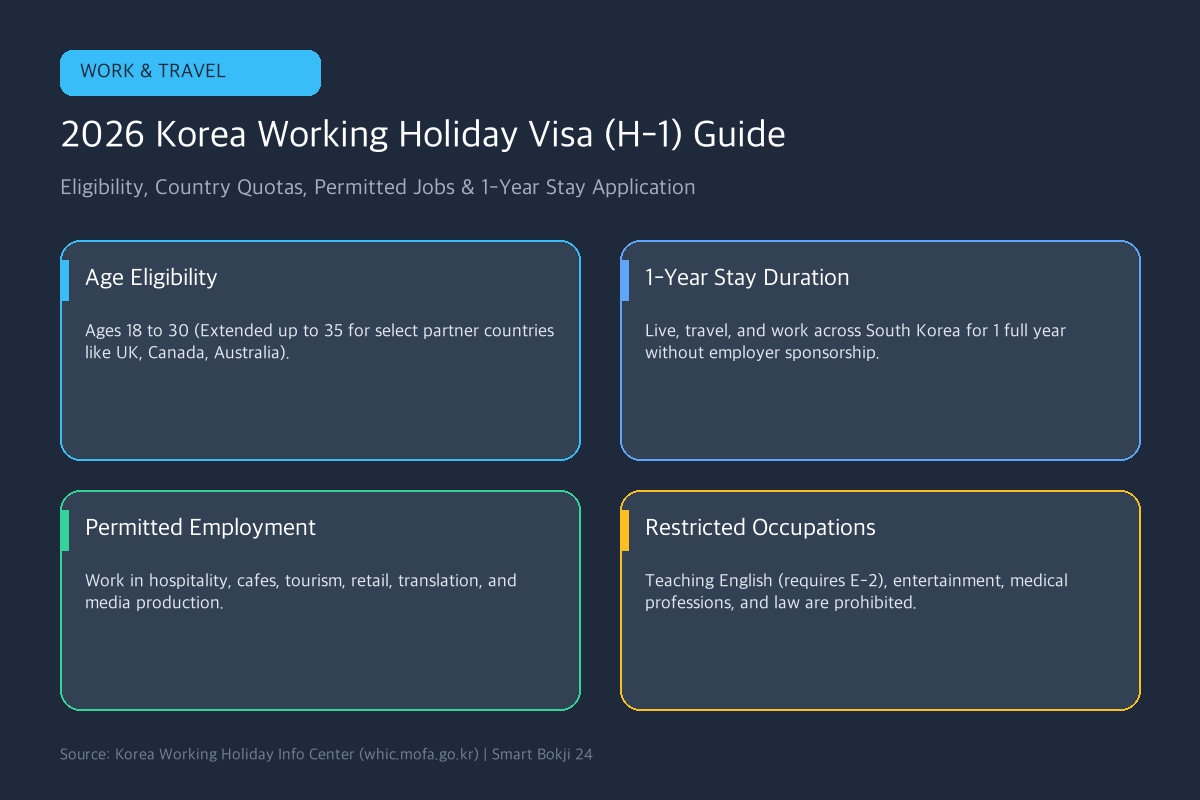
Welcome to the definitive Korea working holiday visa H-1 guide for 2026! Designed for young adventurers aged 18 to 30 (extended up to 35 for select partner nations), the H-1 Working Holiday Visa offers an extraordinary opportunity to travel, immerse yourself in K-culture, and work legally in South Korea for up to one full year without requiring dedicated employer sponsorship.
South Korea has established reciprocal working holiday bilateral agreements with over 25 countries worldwide. In this 2026 comprehensive Korea working holiday visa H-1 guide, we break down mandatory financial proof thresholds, country-specific annual quotas, legally permitted vs strictly prohibited job industries, and the step-by-step embassy application process.
1. Korea Working Holiday Visa H-1 Guide: Key Eligibility Rules
To successfully qualify for an H-1 visa, applicants must satisfy five foundational criteria set by the Ministry of Foreign Affairs (MOFA):
🌟 Core H-1 Visa Requirements
- Age Criteria: Must be aged between 18 and 30 at the time of application (Extended to age 35 for citizens of the UK, Canada, and Australia).
- Financial Proof: Must show a minimum bank account balance of approximately 3,000,000 KRW to 5,000,000 KRW (~$2,500 to $3,800 USD) to support initial living expenses.
- Medical Health Insurance: Proof of comprehensive international health and travel insurance covering at least 40,000,000 KRW in medical costs.
- Primary Purpose: Primary intent must be tourism and cultural exchange, with employment as a secondary activity to finance travel.
- Official Source: Korea Working Holiday Info Center (MOFA).
- Official Source: Ministry of Justice HiKorea Portal.
2. Permitted Jobs vs Strictly Prohibited Occupations
Understanding legal employment boundaries is essential to prevent severe immigration fines or visa revocation:
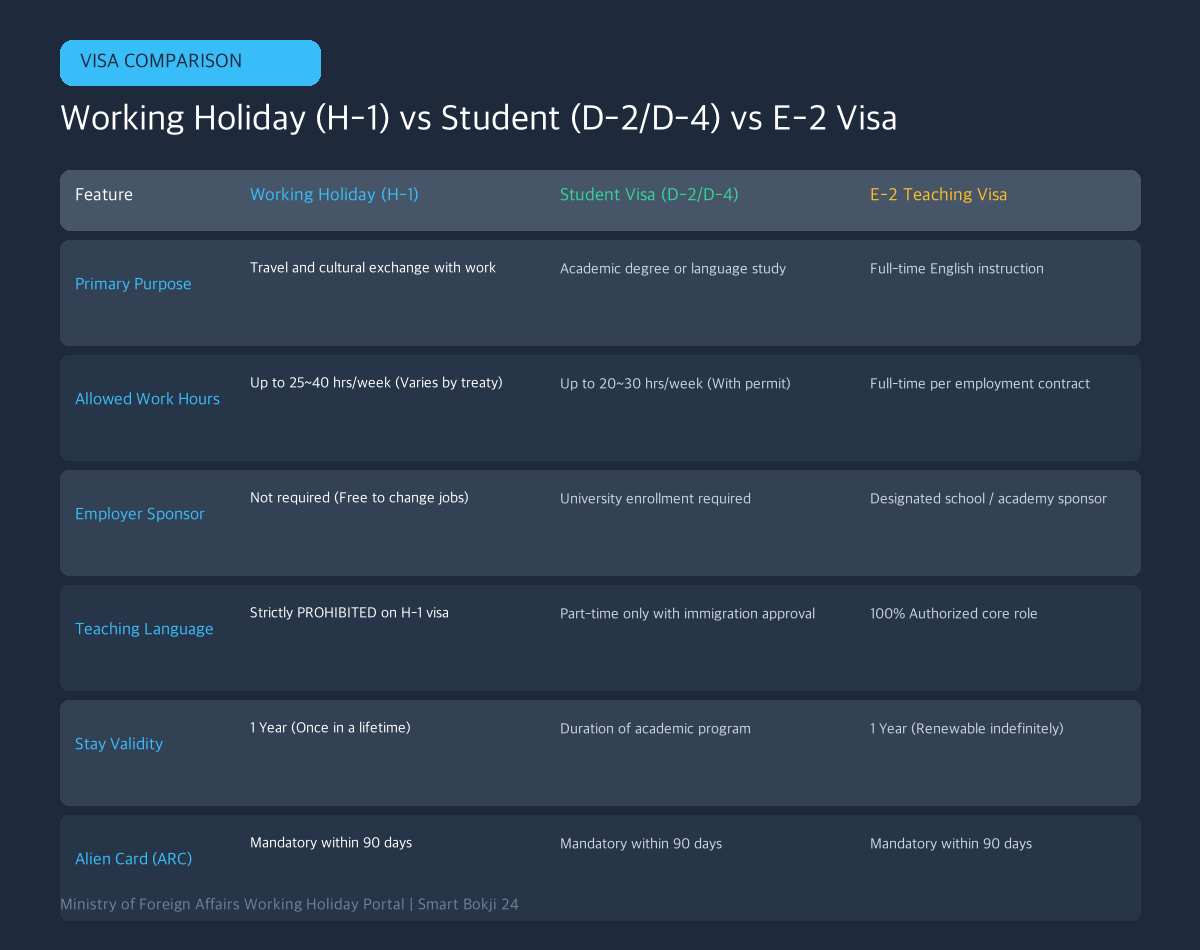
- Permitted Jobs: Hospitality staff at hotels/guesthouses, barista/cafe staff, restaurant service, retail fashion stores, translation/interpretation, content creation, and tourism guide assistance.
- Strictly Prohibited Occupations: Teaching English or foreign languages (strictly requires an E-2 or F-series visa), adult entertainment establishments, professional medical/legal practice, and journalism/broadcasting.
3. Step-by-Step Embassy Application Roadmap
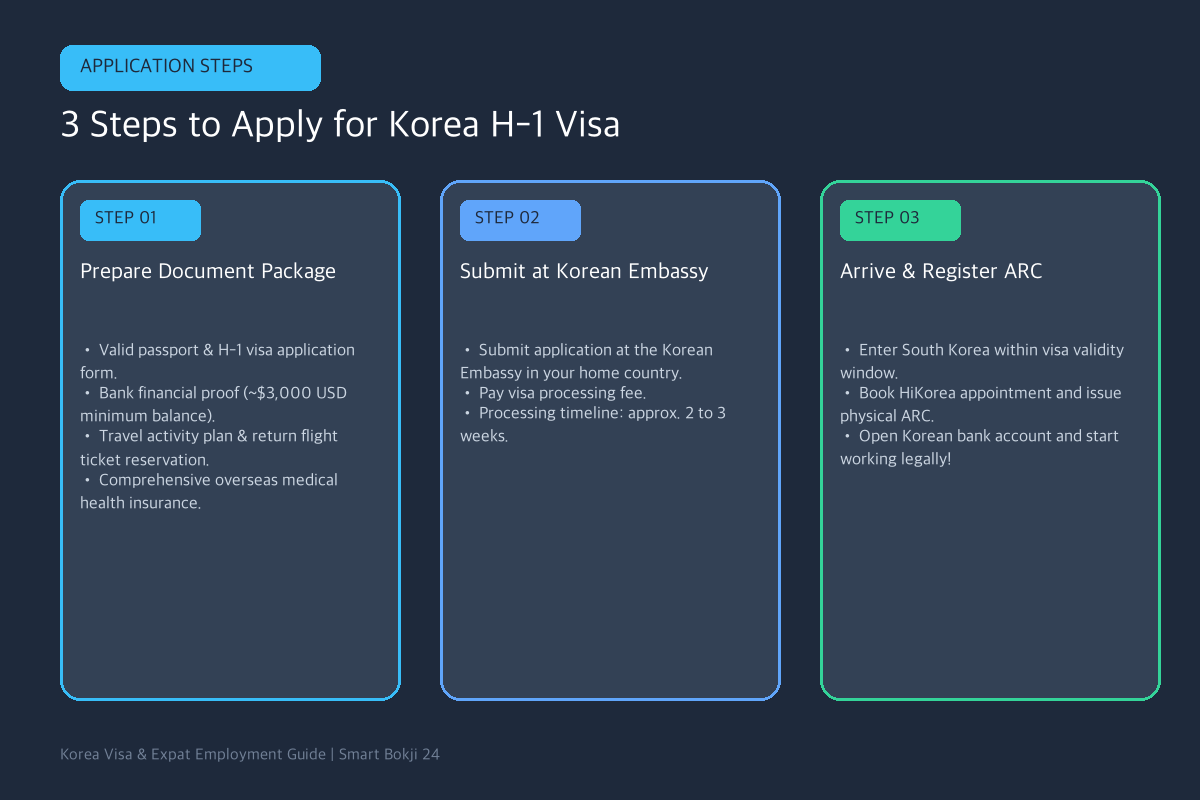
- Step 1: Prepare Document Package: Collect your valid passport, H-1 application form, 3-month bank balance certificate, detailed Travel Activity Plan, flight itinerary, and travel insurance policy.
- Step 2: Submit to Korean Embassy: Book an appointment at the Embassy or Consulate General of the Republic of Korea in your home country. Pay the visa fee and wait 2 to 3 weeks for processing.
- Step 3: Enter Korea & Obtain ARC: Fly to South Korea within your visa entry window. Within 90 days of arrival, book an appointment on HiKorea to issue your physical Alien Registration Card (ARC), open a Korean bank account, and begin your workation journey!
4. Frequently Asked Questions (FAQ)
Q1: Can I extend the H-1 Working Holiday Visa beyond 1 year?
The H-1 visa is granted once in a lifetime for a non-extendable maximum of 1 year (except for US/Canadian citizens who may qualify for reciprocal extension programs).
Q2: Do I have to enroll in Korean National Health Insurance (NHIS)?
Yes. Under Korean statutory regulations, H-1 visa holders staying in Korea are automatically enrolled in the NHIS healthcare program upon reaching their 6-month stay mark.
🔗 Recommended Expat & Housing Guides
- Rent your first studio in Seoul: Read our How to Rent an Apartment in Korea for Foreigners.
- Residence ID application: Check the Korea Alien Registration Card ARC Guide 2026.
- Official Source: Korea Working Holiday Info Center (MOFA).
- Official Source: Ministry of Justice HiKorea Portal.
Quota eligibility is not job permission for every role
The H-1 working holiday status is designed for travel with incidental work, and nationality-specific age, quota, and document rules may apply. Some occupations or work patterns are restricted. Confirm the embassy checklist and immigration rules for your passport rather than relying on another traveler’s approval experience.
Budget for the period before the first paycheck
Prepare funds for accommodation deposits, insurance, transport, phone service, and several weeks of living costs. Review any employment contract for hourly pay, working hours, deductions, housing charges, payday, and termination terms. Keep copies of the contract and wage records. Visa extensions or status changes require a separate immigration check before the current stay expires.