
Korea transportation card is a must-have search topic for first-time travelers visiting Seoul, Busan, Jeju, Incheon, or other parts of South Korea. You can technically buy single journey tickets, but most visitors save time by using a reloadable transit card for subway, buses, taxis, and convenience-store payments. The confusing part is choosing between T-money, Climate Card, WOWPASS, NAMANE, Korea Tour Card, and single tickets.
This 2026 guide compares the main Korea transportation card options for English-speaking tourists. It explains which card is best for a first trip, which card works better for heavy Seoul subway use, how transit cards are different from prepaid payment cards, where to buy and recharge them, and which mistakes to avoid. Information was checked on September 6, 2026, but card prices, coverage, and purchase locations can change, so always confirm final details on the official page before purchase.
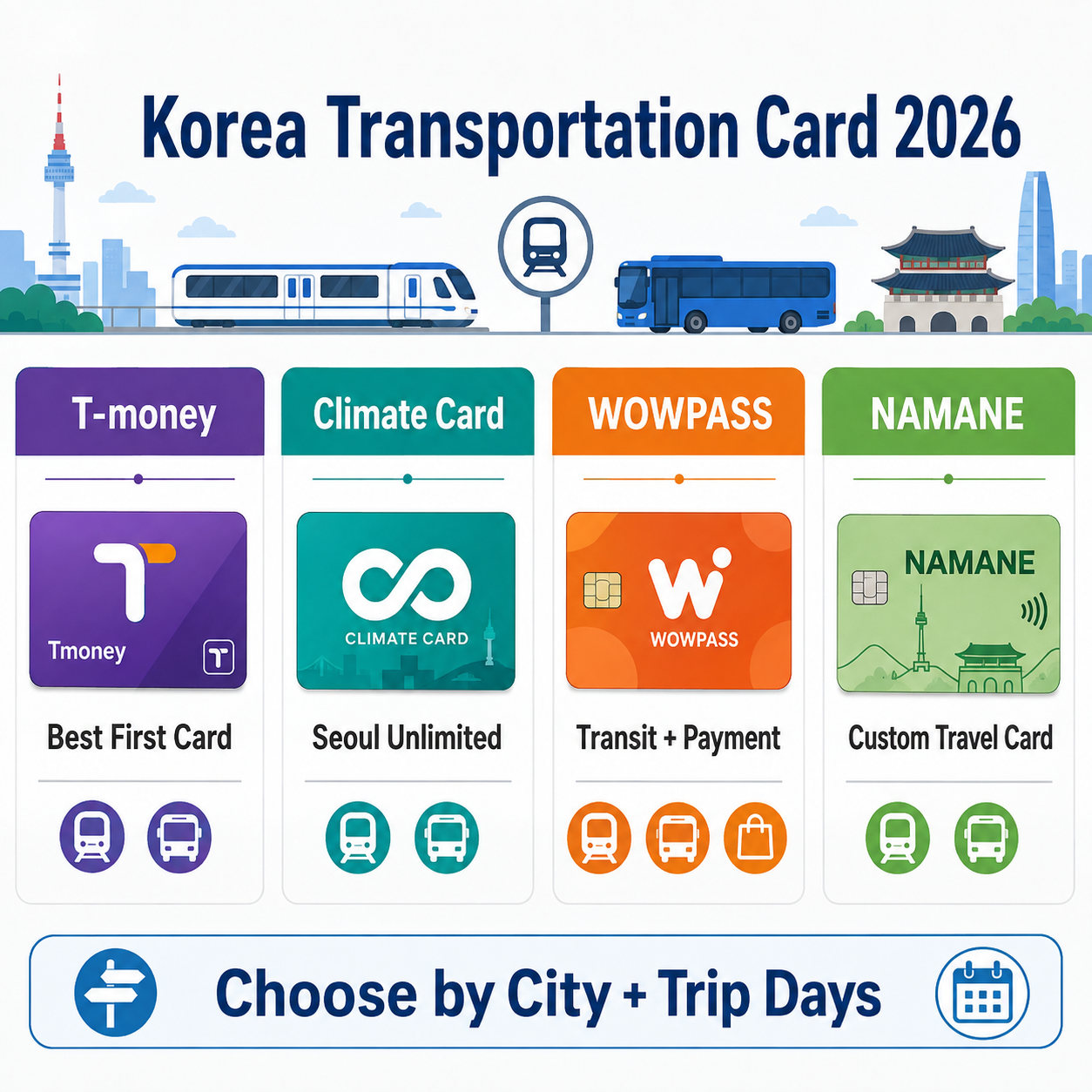
Korea Transportation Card: Quick Recommendation
| Traveler Type | Best First Choice | Why |
|---|---|---|
| First-time visitor traveling around Korea | T-money or Korea Tour Card | Simple, widely accepted, easy to recharge |
| Tourist staying mostly in Seoul for 1-7 days | Climate Card tourist pass | Can be useful for frequent Seoul subway and bus rides |
| Traveler who wants shopping payment plus transit | WOWPASS | Combines prepaid payment features with T-money transit function |
| Traveler who wants a custom-designed card | NAMANE Card | Combines prepaid payment and transportation features with personalization |
| One-time rider | Single journey ticket | Fine for one subway ride, but inconvenient for repeated travel |
What Is a Korea Transportation Card?
A Korea transportation card is a stored-value transit card used to tap in and tap out on public transportation. In most cases, you load Korean won onto the card and pay automatically when you ride subways, buses, and some taxis. Many cards can also be used at convenience stores and selected merchants, depending on the card type.
For tourists, the biggest benefit is convenience. Instead of buying a ticket for every subway ride or preparing exact bus fare, you tap the card at the gate or card reader. In Korea, you should usually tap when entering and exiting subway gates. On buses, tap when boarding and tap again when getting off to receive correct transfer benefits where applicable.
| Feature | Why It Matters | Traveler Tip |
|---|---|---|
| Tap in and tap out | Calculates the right fare and transfers | Do not forget to tap out on buses and subway gates |
| Rechargeable balance | Lets you ride repeatedly without buying tickets | Keep a small cash backup for top-ups |
| Subway and bus use | Covers most everyday tourist routes | Check special trains and intercity routes separately |
| Convenience-store use | Some cards work for small purchases | Payment function depends on the card type |
Main Korea Transportation Card Options in 2026
The best Korea transportation card depends on where you travel and how you pay. A basic T-money card is still the easiest starting point for most tourists. Climate Card can be attractive for heavy Seoul travel. WOWPASS and NAMANE are not just transportation cards; they also work as prepaid payment cards with separate transit functions.
| Card | Main Use | Best For | Important Limitation |
|---|---|---|---|
| T-money | Transit stored-value card | First-time visitors and nationwide travel | Usually needs cash top-up for transit balance |
| Korea Tour Card | Tourist version of T-money with partner benefits | Travelers who want a simple tourist transit card | Benefits and availability can change |
| Climate Card | Seoul unlimited transit pass | Visitors taking many subway and bus rides inside Seoul | Coverage is limited compared with ordinary pay-as-you-go cards |
| WOWPASS | Prepaid payment card plus T-money transit chip | Tourists who want currency exchange, shopping payment, and transit in one card | Payment balance and transit balance are separate |
| NAMANE Card | Custom prepaid card plus transportation function | Travelers who want personalization and payment plus transit | Top-up and refund rules differ by balance type |
| Single journey ticket | One subway ride | Very occasional riders | Slow and inconvenient for repeated rides |
T-money: Best First Card for Most Tourists
T-money is the default answer for many first-time Korea travelers because it is simple and widely recognized. You can buy a T-money card at convenience stores, subway stations, airport stores, and other tourist locations depending on stock. Then you recharge it and tap it on subways, buses, and compatible taxis.
If you are not sure what your itinerary will look like, T-money is usually the safest starting point. It does not lock you into one city or one unlimited-pass period. You simply pay as you go. For travelers visiting Seoul, Busan, Gyeongju, Jeju, and other areas in the same trip, this flexibility matters.
| T-money Strength | Why It Helps | Watch Out |
|---|---|---|
| Widely accepted | Works across many transit systems and stores | Check special routes separately |
| Easy to understand | Top up, tap, ride | Do not forget to maintain enough balance |
| Good for multi-city travel | Useful beyond Seoul-only trips | Some local transport or tourist shuttles may differ |
| No strict travel period | You are not tied to a 1-day or 7-day pass window | Unused balance and refund rules should be checked |
Climate Card: Best for Heavy Seoul Transit Use
The Climate Card is designed for unlimited transit within covered Seoul routes during a selected period. Tourist versions have been promoted for short-term visitors, such as 1-day to 7-day use. It can be a strong choice if you stay mostly inside Seoul and take many subway and bus rides every day.
The important word is “covered.” Climate Card is not the same as a nationwide transit card. If your trip includes Incheon Airport routes, Gyeonggi-do, Busan, Jeju, intercity buses, or special train services, check the coverage carefully. For a detailed Seoul-focused comparison, read our Korea Climate Card vs T-Money 2026 guide.
| Choose Climate Card If | Be Careful If |
|---|---|
| You stay mostly inside Seoul | You plan to visit Busan, Jeju, Suwon, or other cities |
| You take multiple rides per day | You only ride subway once or twice per day |
| You dislike checking remaining balance | You need airport or intercity route coverage |
| You can buy and activate it conveniently | You arrive late or cannot find a purchase location |
WOWPASS: Transit Plus Payment
WOWPASS is popular with foreign travelers because it combines a prepaid payment card, currency exchange features, app balance management, and a T-money transit function in one physical card. For tourists who shop often, dislike carrying too much cash, or want spending notifications, it can be convenient.
The key detail is that the shopping payment balance and transportation balance are separate. You may need to top up the transit balance separately, usually with Korean won cash at supported locations. For a payment-focused explanation, read our WOWPASS Korea Card Guide 2026.
| WOWPASS Feature | Why Travelers Like It | Important Note |
|---|---|---|
| Prepaid shopping payment | Useful at many Korean card readers | Merchant acceptance and limits should be checked |
| T-money transit chip | Works like a transit card after top-up | Transit balance is separate from payment balance |
| Currency exchange kiosks | Helpful for travelers carrying foreign cash | Kiosk locations and fees can change |
| Mobile app | Helps track spending and card status | App setup and recovery rules should be checked |
NAMANE Card: Custom Travel Card
NAMANE Card is another tourist-friendly option that combines a prepaid payment card with a transportation function. It is known for custom card designs, making it popular with travelers who want a personalized souvenir-like card that also has practical use.
Like WOWPASS, travelers should understand the difference between payment balance and transportation balance. If you are buying NAMANE mainly for the design, make sure you also understand where you can top it up, how refunds work, and whether it fits your travel route.
| NAMANE Use Case | Good For | Check Before Buying |
|---|---|---|
| Personalized card design | Travelers who want a keepsake card | Kiosk location and printing process |
| Transit function | Subway and bus rides after transport top-up | Transportation balance top-up method |
| Prepaid payment | Small purchases and travel spending | Payment limits, accepted merchants, and refunds |
Which Card Should You Choose?
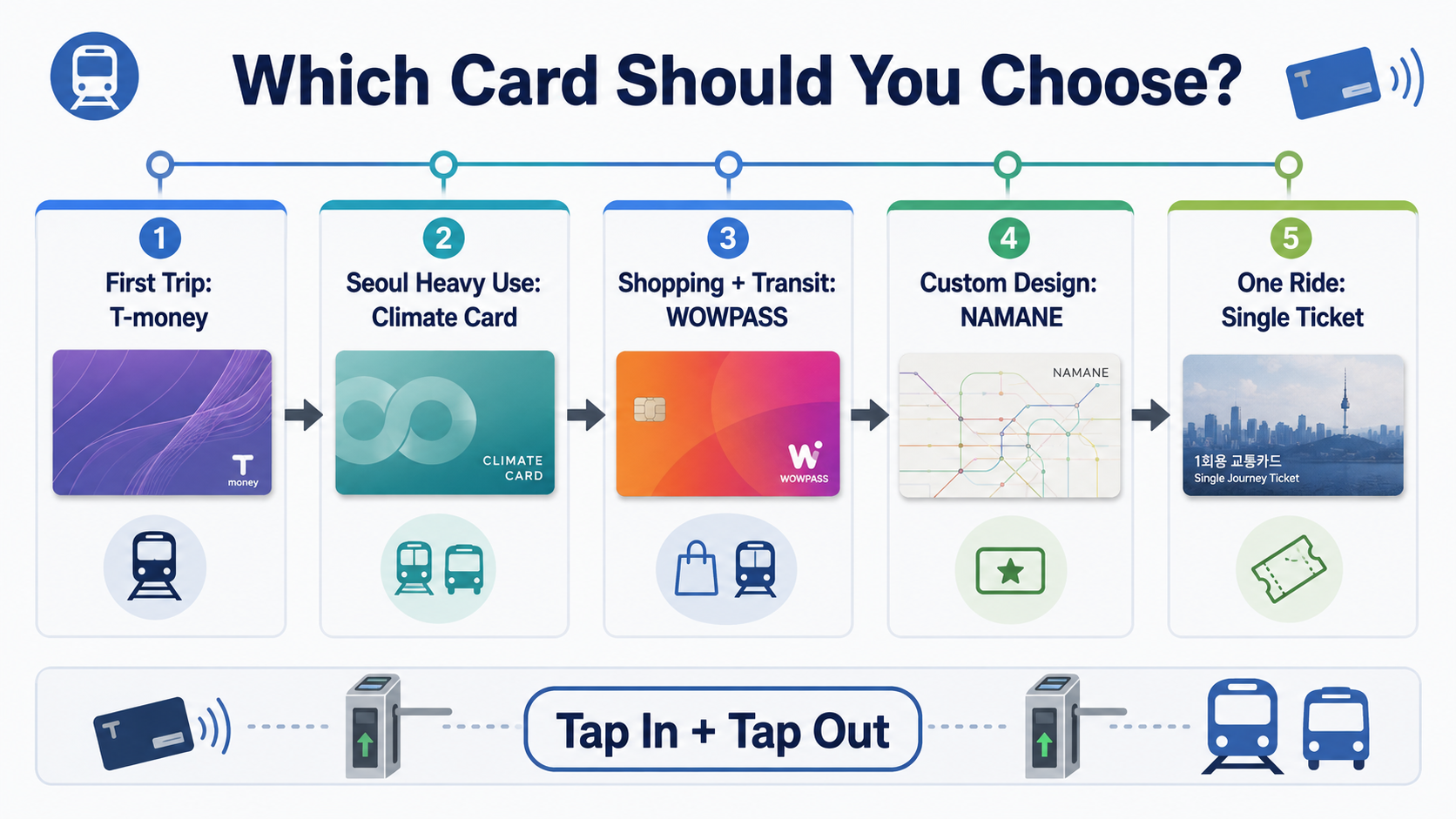
| Your Situation | Recommended Card | Reason |
|---|---|---|
| First trip to Korea and uncertain itinerary | T-money or Korea Tour Card | Most flexible and easy to understand |
| 3-5 days in Seoul with many subway rides | Climate Card | Unlimited covered rides may be useful |
| K-beauty, shopping, and transit in one card | WOWPASS | Payment features plus transit chip |
| Personalized card design and transit | NAMANE Card | Custom design plus transport function |
| One subway ride only | Single journey ticket | No need to buy a stored-value card |
Where to Buy and Recharge
Purchase and recharge locations depend on the card. T-money and tourist transit cards are commonly available at convenience stores, subway stations, airport locations, and tourist information points. Climate Card purchase and recharge rules are more specific, so check Seoul’s official guide before relying on it. WOWPASS and NAMANE depend on kiosks, app support, and partner locations.
| Card | Where to Buy | Recharge Method |
|---|---|---|
| T-money | Convenience stores, subway stations, airport stores, tourist shops | Subway machines and convenience stores, often cash for transit top-up |
| Korea Tour Card | Tourist sales locations and selected convenience stores | Similar to T-money, depending on product type |
| Climate Card | Designated Seoul locations and subway-related sales points | Seoul subway machines or official supported methods |
| WOWPASS | WOWPASS kiosks and partner locations | WOWPASS payment balance and T-money transit balance may be topped up separately |
| NAMANE | NAMANE kiosks and app-connected locations | Payment and transportation balance rules differ |
Can You Use One Card for Everything?
No single card is perfect for every tourist. T-money is excellent for transit, but it is not a full travel payment solution. WOWPASS and NAMANE add payment functions, but their transit balance can still be separate. Climate Card can be convenient inside Seoul, but it is not designed as a general nationwide travel card. If you travel outside Seoul, keeping a basic T-money-compatible card is still a practical backup.
Common Mistakes to Avoid
| Mistake | Why It Causes Problems | Better Action |
|---|---|---|
| Assuming Climate Card works everywhere | It has coverage limits | Check Seoul and route coverage before buying |
| Not separating payment and transit balances | WOWPASS and NAMANE may use separate balances | Top up the transportation balance before riding |
| Forgetting to tap out | Fare or transfer benefits may be affected | Tap when entering and exiting where required |
| Only carrying a foreign credit card | Some machines or top-ups may need Korean won cash | Keep a small cash backup |
| Buying too many cards | Unused balances and refund rules become annoying | Start with one main card and add only if needed |
Suggested Setup for a First Korea Trip
| Trip Plan | Suggested Setup | Why |
|---|---|---|
| Seoul only, 1-2 days | T-money or Climate Card depending on ride count | Compare expected subway and bus rides |
| Seoul only, 3-7 days, many rides | Climate Card plus small cash backup | Unlimited covered Seoul transit may help |
| Seoul plus Busan or Jeju | T-money or Korea Tour Card | More flexible for multi-city travel |
| Shopping-heavy Seoul trip | WOWPASS plus T-money balance | Payment and transit in one physical card |
| Longer stay or personal card preference | NAMANE or T-money plus local payment app later | Choose based on top-up and refund convenience |
Related Korea Travel Guides
- Korea Climate Card vs T-Money 2026
- WOWPASS Korea Card Guide 2026
- Incheon Airport to Seoul Transportation Guide 2026
- Korea SIM vs eSIM 2026
- Must Have Apps for Traveling in Korea 2026
FAQ
What is the best transportation card in Korea for tourists?
For most first-time tourists, T-money or Korea Tour Card is the easiest first choice. If you stay mostly inside Seoul and ride many times per day, Climate Card may be better. If you want payment plus transit, compare WOWPASS and NAMANE.
Can I use T-money outside Seoul?
T-money is widely used beyond Seoul, but coverage can vary by local transport type and route. Check special buses, airport routes, ferries, and local tourist shuttles separately.
Is Climate Card better than T-money?
Climate Card can be better for frequent covered rides inside Seoul. T-money is usually better for flexible multi-city travel or light transit use.
Does WOWPASS include T-money?
WOWPASS includes a T-money transit function, but the shopping payment balance and transportation balance are separate. You may need to top up the transit balance separately.
Can I pay for Korean subway with a foreign credit card?
Some newer contactless payment options exist, but tourists should not rely on a foreign credit card for every subway or bus ride. A local transportation card is still the safer setup.
Do I need cash to recharge a transportation card?
In many cases, yes. Some subway machines and convenience stores may require Korean won cash for transit balance top-up. Keep small bills as a backup.
Can two people use one transportation card?
For ordinary subway and bus travel, each passenger should use their own card. Sharing one card at the same gate or bus ride is not the normal tourist setup.
Final Takeaway
The best Korea transportation card is the one that matches your route. Choose T-money or Korea Tour Card for a flexible first trip, Climate Card for heavy covered Seoul transit, WOWPASS for shopping plus transit, and NAMANE if you want a personalized prepaid card with transit function. For most visitors, starting with one simple transit card and adding a payment-focused card only if needed is the cleanest plan.
Official Sources
- Seoul Metropolitan Government official English portal
- T-money official website
- Korea Tour Card official website
- WOWPASS official website
- NAMANE official website
- Visit Seoul transportation guide
🏛️ Official Public References
- Official Source: Korail Metro & Transit.