
South Korea has officially emerged as one of the most exciting workation destinations in Asia, thanks to the launch and expansion of the Korea digital nomad visa (officially designated as the F-1-D Workation Visa). Designed specifically for global remote workers, software engineers, and digital entrepreneurs employed by overseas companies, this official visa allows foreign nationals to live and work remotely in South Korea for up to two full years while enjoying Korea’s world-class internet infrastructure, vibrant cafe culture, and safe urban environment.
In this definitive 2026 guide, we break down everything you need to know about the Korea digital nomad visa, including mandatory annual income thresholds, required health insurance coverage, step-by-step application procedures via Korean embassies and the HiKorea immigration portal, and essential legal boundaries regarding local employment and taxation.
1. Key Benefits of the Korea Digital Nomad Visa (F-1-D)
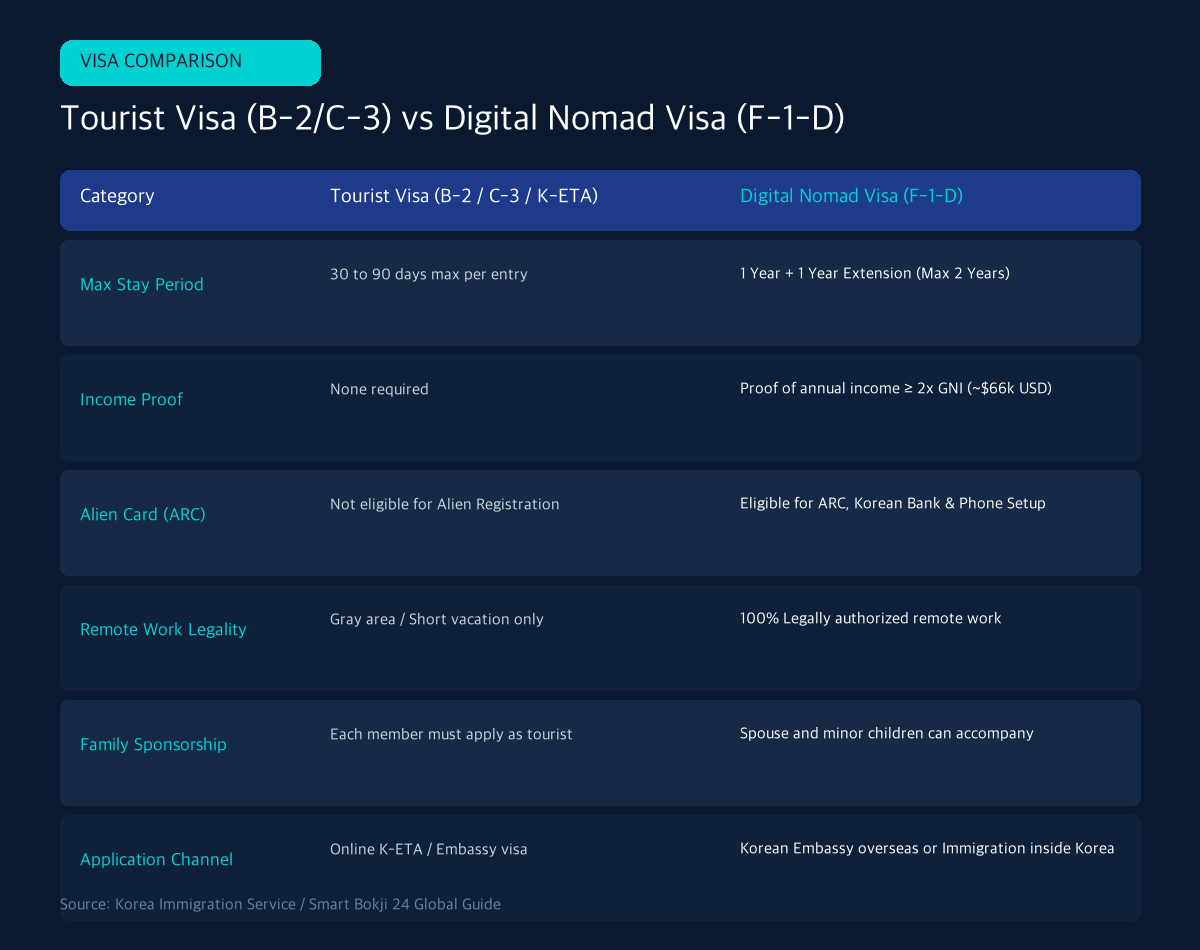
Unlike standard tourist entry permits (B-2 or K-ETA) which limit stays to 30 to 90 days with no formal right to register locally, the official Korea digital nomad visa grants remote professionals legitimate residential status in South Korea.
🌟 Core Advantages of the F-1-D Workation Visa
- Extended Stay Duration: Granted for an initial period of 1 Year, extendable for an additional 1 Year (Total 2 Years).
- Alien Registration Card (ARC): Eligible to obtain a Korean Residence Card, enabling you to sign long-term apartment leases, open local Korean bank accounts, and register for postpaid mobile plans.
- Family Inclusion: You can bring your legal spouse and minor children under the accompanying workation status.
- 100% Legal Remote Work: Conduct work legally for overseas employers without violating Korean immigration laws.
2. Eligibility & Minimum Income Requirements (2026)
To qualify for the Korea digital nomad visa, applicants must demonstrate substantial financial stability and steady employment with an overseas company or multinational enterprise. The Korean Ministry of Justice evaluates applicants based on four mandatory pillars:
- Annual Income Criteria: Applicants must earn at least twice the previous year’s Gross National Income (GNI) per capita of South Korea. For 2026, this translates to approximately 88,000,000 KRW to 90,000,000 KRW per year (approx. $66,000 to $68,000 USD) before taxes.
- Employment Status: Must be employed by a company registered outside South Korea for at least 1 continuous year in the same industry. Self-employed freelancers with verifiable client contracts and tax returns are also eligible.
- Private Health Insurance: Proof of comprehensive international medical insurance with emergency evacuation coverage of at least 100,000,000 KRW (approx. $75,000 USD).
- Clean Criminal Record: Official police clearance certificate apostilled or consular-authenticated from your home country.
3. Step-by-Step Application Process
Applying for the Korea digital nomad visa can be completed either from your home country through a Korean diplomatic mission or directly inside South Korea if you are currently staying on an eligible short-term visa.
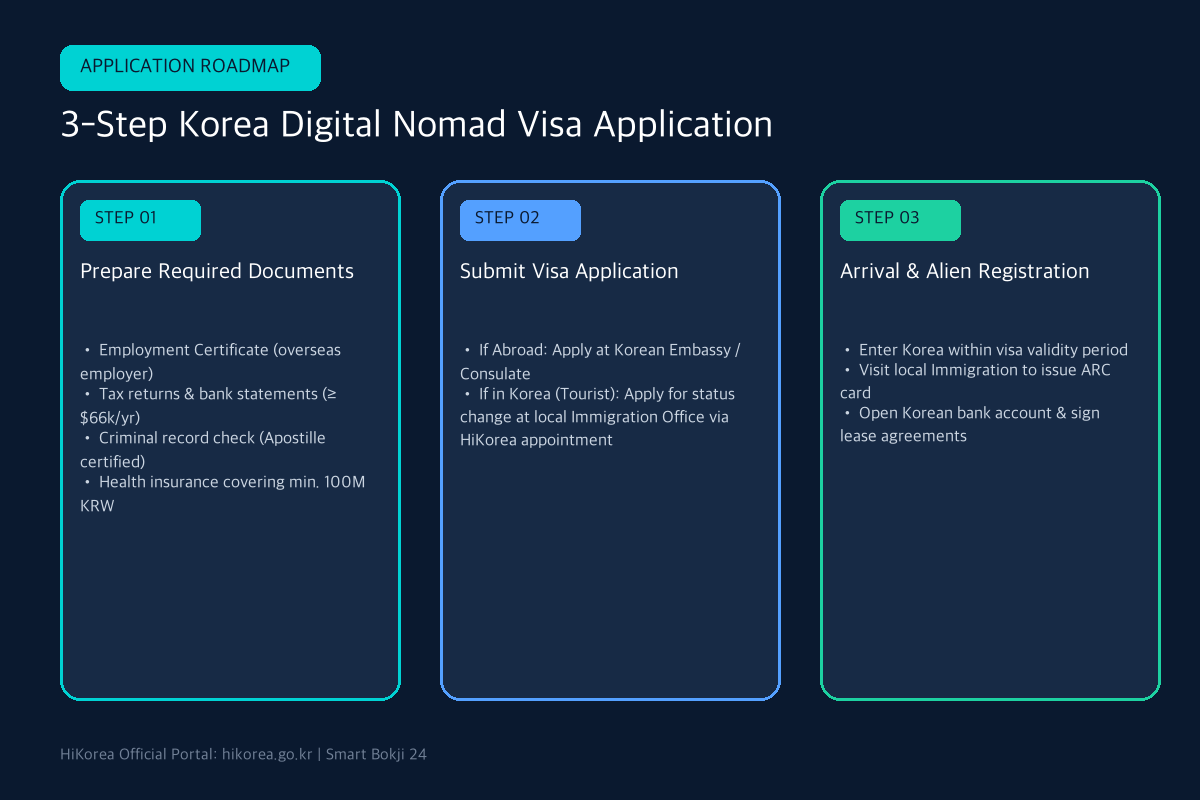
Step 1: Document Preparation Checklist
Gather and translate the following essential documents into Korean or English:
- Valid Passport with at least 6 months of remaining validity.
- Completed Visa Application Form (Form No. 17).
- Certificate of Employment & Business Registration of your overseas employer.
- Bank statements, wage slips, and official tax payment certificates proving income over the past 12 months.
- Apostilled Nationwide Criminal History Record Certificate.
- Medical Insurance Certificate with coverage ≥ 100M KRW.
Step 2: Submitting Your Application
If applying abroad, submit your application package to the nearest Embassy or Consulate General of the Republic of Korea. If you are already inside South Korea on a visa-free entry or tourist visa (excluding certain restricted nationalities), you can book an appointment on the official HiKorea Portal and apply for a change of status at your jurisdiction’s Immigration Office.
Step 3: Receiving Your ARC & Settling in Korea
Upon approval, schedule an appointment with your local immigration office within 90 days of arrival to register your biometric data and receive your physical Alien Registration Card (ARC). With your ARC in hand, you can immediately open a Korean bank account (KB, Shinhan, or Hana Bank), set up high-speed 5G mobile service, and explore co-working spaces in Seoul, Busan, or Jeju Island.
4. Crucial Legal Rules & Tax Considerations
⚠️ Mandatory Legal Boundaries
Strict Prohibition of Local Employment: The F-1-D visa strictly forbids engaging in local economic activities or being hired by Korean domestic companies. If you wish to work for a Korean firm, you must formally transition to an E-7, E-2, or D-8 visa category.
5. Frequently Asked Questions (FAQ)
Q1: Can self-employed freelancers apply for the Korea digital nomad visa?
Yes. Self-employed professionals and independent contractors can apply, provided they provide verifiable business records, client contracts, and tax returns meeting the 2x GNI income threshold.
Q2: Do I have to pay income tax in South Korea on this visa?
Generally, remote workers receiving salary from overseas employers are treated as non-permanent residents during their initial stay. However, tax residency rules depend on bilateral tax treaties between Korea and your home country.
Q3: Can I extend my stay beyond 2 years?
The F-1-D visa is limited to a maximum total stay of 2 years (1 year initial + 1 year renewal). To stay longer, nomads typically transition to other visa types such as D-8 (Business Investment), D-10 (Job Seeking), or F-2 (Points-based Resident).
🔗 Essential Guides for Living in Korea
- Looking for unlimited subway & bus travel in Seoul? Check our Korea Climate Card vs T-Money 2026 Guide.
- Shopping for electronics or K-beauty? Read our step-by-step Complete Korea Tax Refund Guide 2026.
- Official Immigration Application Portal: Visit the Republic of Korea Ministry of Justice HiKorea Official Website.