
Korea severance pay for foreign workers is one of the most important money checks before leaving a job in South Korea. If you worked for the same employer for at least one year and met the weekly working-hour requirement, you may be entitled to statutory severance pay under Korean retirement benefit rules. However, the amount, payment method, and timing depend on your work period, wage record, contract type, and whether you are covered by a separate departure guarantee insurance system.
This guide explains Korea severance pay eligibility, the basic calculation formula, documents to prepare, how the 14-day payment rule works, and how severance pay is different from the Korea pension refund for foreigners. It is written for English-speaking employees, foreign workers, teachers, office workers, factory workers, and long-term residents preparing to resign or leave Korea.
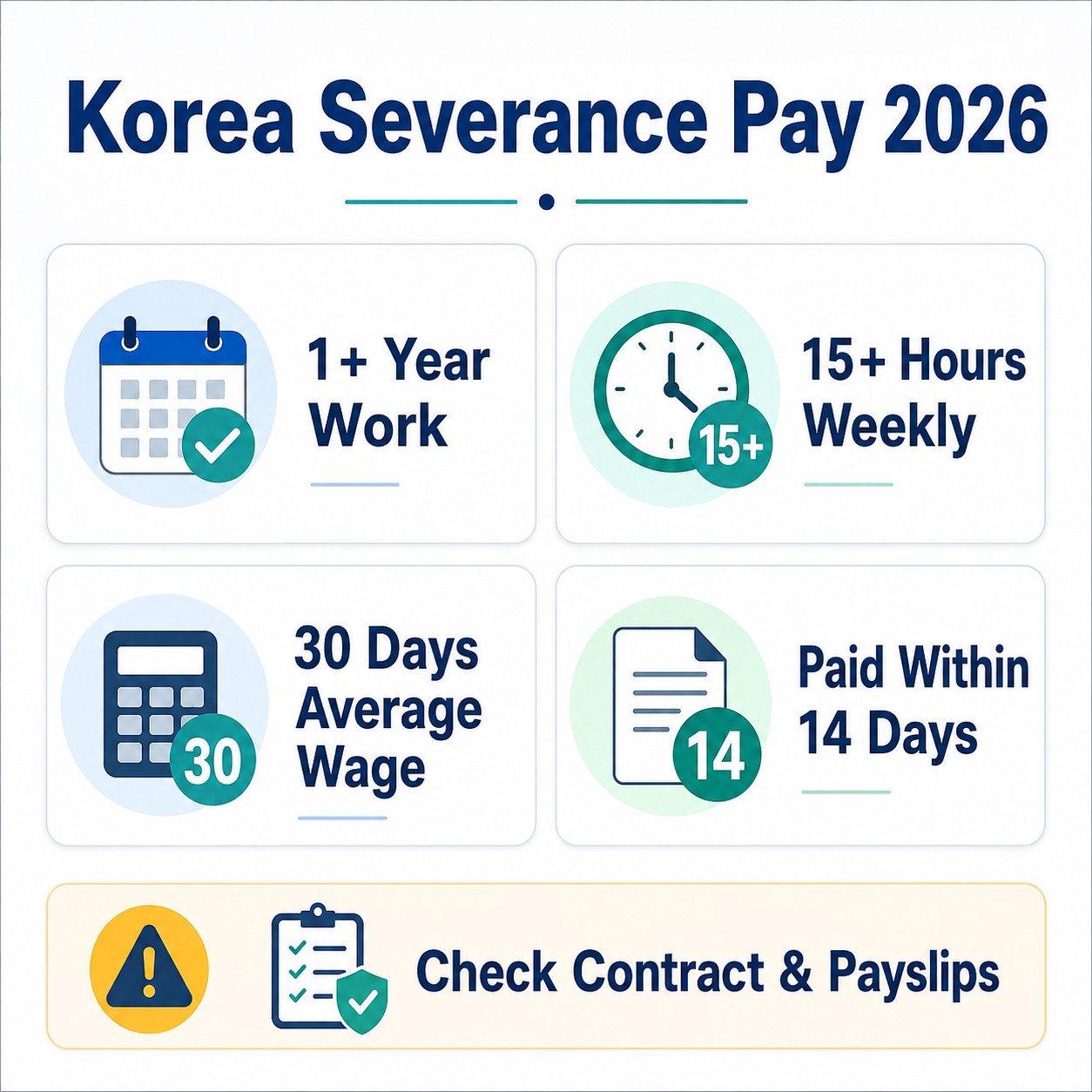
Korea Severance Pay for Foreign Workers: Quick Summary
| Question | Short Answer | Why It Matters |
|---|---|---|
| Who can receive severance pay? | A worker who has generally worked at least 1 year for the same employer and meets the weekly-hour requirement | This is the first eligibility check before estimating the amount |
| How is it calculated? | Usually based on 30 days of average wage for each year of continuous service | Your last 3 months of wage records can matter |
| When should it be paid? | Generally within 14 days after retirement, unless the parties agree to extend the payment date | This helps you plan departure and cash flow |
| Is it the same as pension refund? | No. Severance pay is paid by the employer or related retirement system; pension refund is handled through NPS rules | Many foreign workers confuse the two |
| Is every case automatic? | No. Contract status, hours, work period, insurance, and documentation can change the process | Keep records before leaving the workplace |
Is Severance Pay Available to Foreign Workers in Korea?
In Korea, statutory severance pay is not limited to Korean nationals. Foreign workers can also be covered if they meet the legal requirements. The main practical checks are whether you worked continuously for the same employer for at least one year and whether your regular weekly working hours meet the threshold.
For many full-time foreign employees, this is straightforward. For part-time workers, short-term workers, dispatch workers, hagwon teachers, and workers with contract renewals, the facts should be checked more carefully. The name of your visa does not automatically decide everything. Your actual employment relationship, wage record, work period, and working hours matter.
| Worker Situation | Typical Check | Important Note |
|---|---|---|
| Full-time employee | Usually check 1+ year continuous work and wage records | Keep monthly payslips and employment contract |
| Part-time worker | Check weekly working hours and continuous service | Low weekly hours may affect eligibility |
| E-9 or H-2 worker | Check departure guarantee insurance and any employer difference payment | The insurance payout may function similarly to severance pay |
| Foreign teacher or office worker | Check contract term, renewals, and actual resignation date | Contract wording and real work history should match |
| Freelancer or contractor | Check whether the relationship is legally treated as employment | Individual review may be needed |
Basic Eligibility Rules
The common eligibility standard is often summarized as “one year of continuous service and 15 or more hours per week on average.” In practical terms, this means a worker should not only count calendar months but also confirm weekly working time, contract renewals, unpaid leave, and any break between contracts.
| Eligibility Item | What to Check | Documents That Help |
|---|---|---|
| Continuous service | Whether you worked for the same employer for at least 1 year | Employment contract, renewal contract, certificate of employment |
| Weekly hours | Whether your average weekly working hours meet the threshold | Schedule, attendance record, payslip, contract |
| Retirement or resignation | Whether the employment relationship has ended | Resignation letter, termination notice, final work date record |
| Wage record | Wages paid during the calculation period | Last 3 months of payslips and bank deposits |
How to Calculate Korea Severance Pay
The statutory severance pay formula is commonly explained as 30 days of average wage for each year of continuous service. A practical formula used by Korean guidance pages is:
Severance pay = 1 day average wage × 30 days × total days of service ÷ 365
Average wage generally uses the wages paid during the three months before the calculation reason occurred, divided by the total calendar days in that period. If the calculated average wage is lower than ordinary wage, ordinary wage may be used as the average wage under Korean wage rules.
| Input | Meaning | Example Check |
|---|---|---|
| 1 day average wage | Average daily wage based on the relevant wage period | Use payslips and bank records |
| 30 days | Statutory base for each year of service | Do not replace this with one calendar month without checking |
| Total days of service | Continuous working period from start to retirement | Contract renewals may still count if service was continuous |
| 365 | Annual conversion factor | Used to prorate service days |
Simple Example Calculation
The example below is simplified for understanding. Your actual calculation may differ depending on bonuses, allowances, unpaid leave, excluded periods, ordinary wage, and retirement pension rules.
| Example Item | Value | Calculation |
|---|---|---|
| Average daily wage | KRW 100,000 | Based on recent wage records |
| Service period | 730 days | About 2 years |
| Formula | 100,000 × 30 × 730 ÷ 365 | Average daily wage × 30 × service days ÷ 365 |
| Estimated severance pay | KRW 6,000,000 | Before tax and case-specific adjustments |
Payment Deadline: The 14-Day Rule
Under Korea’s retirement benefit payment rule, an employer generally pays severance pay within 14 days after the reason for payment occurs. In many cases, this means within 14 days after retirement. However, if there are special circumstances, the payment date may be extended by agreement between the parties.
If you are leaving Korea soon after resignation, discuss the payment method early. Ask whether the payment will go to your Korean bank account, overseas account, retirement pension account, or another permitted method. Do not close your Korean bank account too early if you still expect final wages, severance pay, tax adjustments, or pension refund payments.
| Timing | What to Do | Reason |
|---|---|---|
| 1 month before leaving job | Check contract, payslips, and estimated service period | Enough time to correct records |
| Before final workday | Confirm final wage, severance estimate, and payment date | Avoid confusion after departure |
| After retirement | Track whether payment is made within the expected period | Helps document unpaid wage issues |
| Before leaving Korea | Keep bank account and contact details active if possible | Final payments may arrive after your last workday |
Severance Pay vs Korea Pension Refund
Foreign workers often mix up severance pay and pension refund because both can be received around the time of leaving Korea. They are different systems. Severance pay is related to your employment relationship with your employer. Pension refund is related to National Pension Service rules and depends on nationality, visa status, social security agreements, and contribution history.
| Item | Severance Pay | Pension Refund |
|---|---|---|
| Main source | Employer or retirement benefit system | National Pension Service rules |
| Key question | Did you work long enough for the employer? | Are you eligible by nationality, visa, and contribution record? |
| Typical timing | After retirement or resignation | Usually when leaving Korea or after losing eligibility |
| Documents | Contract, payslips, bank records, resignation details | Passport, ARC, bank account, departure proof, NPS forms |
| Related guide | This article | Korea Pension Refund for Foreigners 2026 |
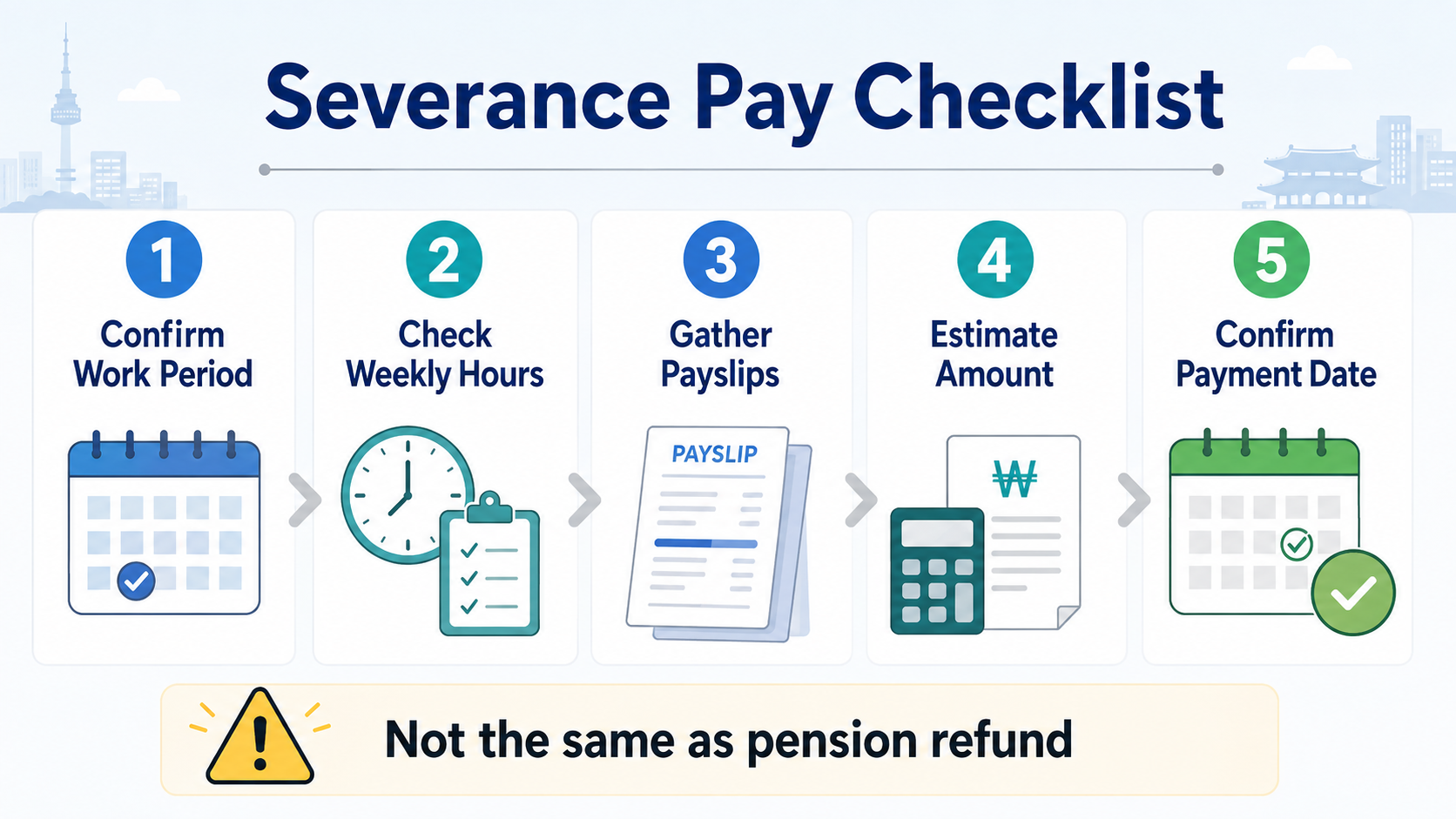
Checklist Before Leaving Your Job
| Checklist Item | Why It Matters |
|---|---|
| Employment start date and final work date | Confirms the service period used in the formula |
| Weekly working hours | Important for eligibility, especially part-time workers |
| Last 3 months of payslips | Needed for average wage estimation |
| Bank deposit records | Useful if payslip and actual payment differ |
| Written payment date | Helps avoid misunderstanding after resignation |
| Korean bank account status | Final wage and severance may be paid after the last workday |
Special Note for E-9 and H-2 Workers
For some foreign workers, especially E-9 and H-2 workers, the departure guarantee insurance system may be involved. This insurance payout is designed to function similarly to severance pay when the worker has worked for one year or more. If the insurance payout is lower than the statutory severance pay amount, the employer may have to pay the difference under the relevant rules.
If this applies to you, do not only ask “Will I get severance pay?” Ask which system will pay it, whether there is any difference between the insurance payout and statutory severance amount, and what documents are needed before departure.
Common Mistakes
| Mistake | Why It Causes Problems | Better Action |
|---|---|---|
| Confusing severance pay with pension refund | You may contact the wrong institution | Check employer payment and NPS refund separately |
| Leaving Korea before confirming payment details | It becomes harder to collect documents and communicate | Confirm amount, date, and bank account before departure |
| Not saving payslips | Average wage calculation becomes harder to verify | Download payslips and bank records before losing system access |
| Assuming every contract worker is excluded | Legal employment status may differ from contract wording | Review actual work relationship and hours |
| Closing the Korean bank account too early | Final wage, severance, tax refund, or pension refund may still arrive | Keep the account open until final payments are settled if possible |
Related Money Guides for Foreigners in Korea
- Korea Pension Refund for Foreigners 2026
- Korea Health Insurance for Foreigners NHIS Guide 2026
- How to Open Bank Account in Korea for Foreigners 2026
- Complete Korea Tax Refund Guide 2026
FAQ
Can foreign workers receive severance pay in Korea?
Yes, foreign workers can receive severance pay if they meet the legal requirements, such as continuous service and weekly-hour conditions. The result depends on the actual employment facts.
How many years do I need to work to receive severance pay?
The common baseline is at least one year of continuous work for the same employer. If your contract was renewed, check whether the service period was continuous.
How is Korea severance pay calculated?
A common formula is 1 day average wage × 30 days × total days of service ÷ 365. The average wage usually uses recent wage records, but special cases can affect the calculation.
When should my employer pay severance pay?
It is generally paid within 14 days after retirement, unless the employer and worker agree to extend the payment date due to special circumstances.
Is severance pay the same as NPS pension refund?
No. Severance pay is related to your employer and employment period. Pension refund is related to National Pension Service contribution and eligibility rules.
Do E-9 and H-2 workers have different rules?
They may be covered through departure guarantee insurance. If the insurance payout is less than the statutory severance amount, the employer may need to pay the difference under relevant rules.
Should I keep my Korean bank account open?
Yes, if possible, keep it open until final wage, severance pay, pension refund, and tax-related payments are settled.
Final Takeaway
Korea severance pay for foreign workers can be a meaningful final payment, but it should be checked carefully before resignation or departure. Confirm your work period, weekly hours, recent payslips, payment date, and bank account before leaving the workplace. If you are also leaving Korea, handle severance pay and pension refund as two separate money tasks.